































What is a Linear Stage? The Ultimate Selection Guide for Precision Motion
In the world of high-stakes manufacturing and scientific research, precision is the primary currency. Whether you are aligning optical fibers, performing laser stent cutting, or conducting high-resolution tomography, the success of your project hinges on one component: the linear stage.
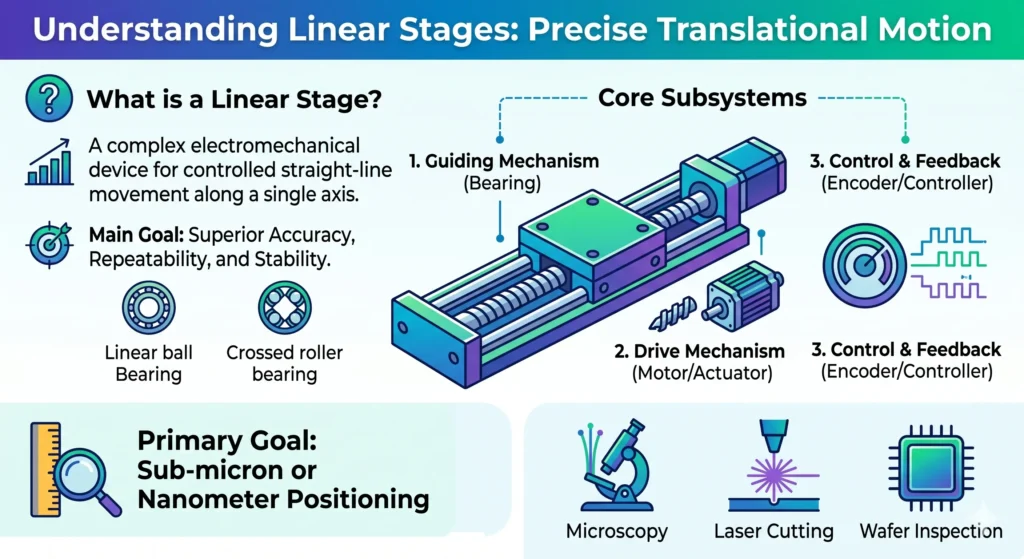
A linear stage (often referred to as a stage linear system) is a precision positioning device designed to provide controlled, straight-line motion along a single axis. While the concept of moving an object in a straight line sounds simple, achieving linear stage precision at the sub-micron or nanometer level requires a complex synergy of mechanical engineering and electronic control.
The Anatomy of a Precision Linear Stage
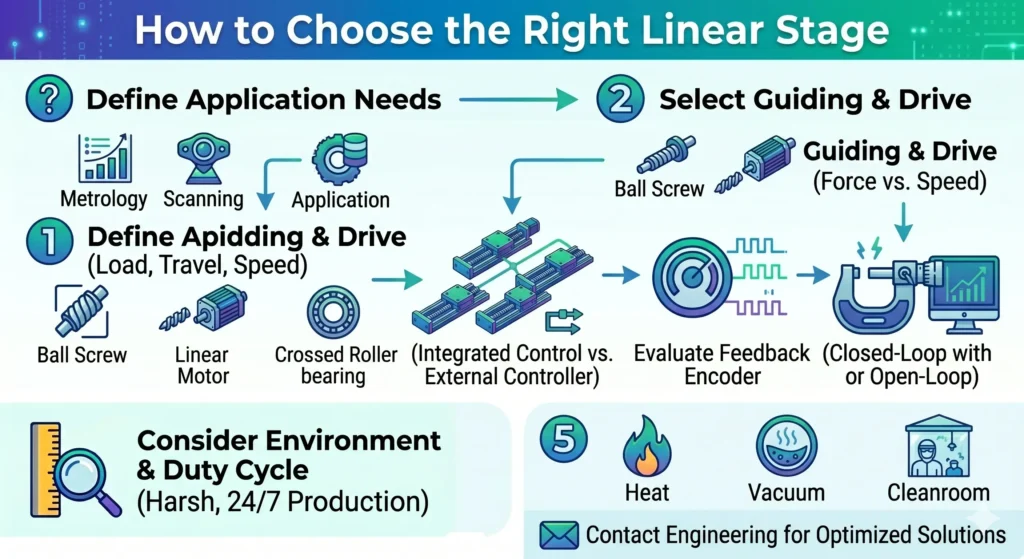
To understand how these systems deliver repeatable results, we must look at the four core components that make up a professional-grade assembly:
The Base and Carriage: The structural foundation, typically built from high-stiffness materials like stress-relieved aluminum or granite to minimize thermal expansion and vibration.
Guiding Mechanisms: These bearings constrain the motion to a single translational axis. Common types include linear ball bearings, crossed roller bearings (ideal for high stiffness), and air bearings for friction-free movement.
The Drive Mechanism: This is the “engine” of the stage. While manual stages use micrometer heads, motorized versions utilize precision ground ballscrews for high thrust or direct-drive linear motors for high-speed, zero-backlash performance.
The Feedback System: High-end precision linear stages incorporate encoders or linear scales to provide real-time position data, enabling closed-loop control to maintain exact positioning despite external forces.
Why the Shift from Manual to Motorized?
While manual stages are useful for static lab setups, they fall short in modern industrial environments for three reasons:
Throughput: Motorized stages can execute complex motion profiles at speeds manual adjustment cannot match.
Repeatability: Automated systems remove human error, returning to the exact same coordinate millions of times with nanometer variance.
Integration: Motorized systems can be “daisy-chained” and controlled via software, allowing for complex multi-axis (XY or XYZ) coordination.
Selecting the Right Architecture: A Technical Comparison
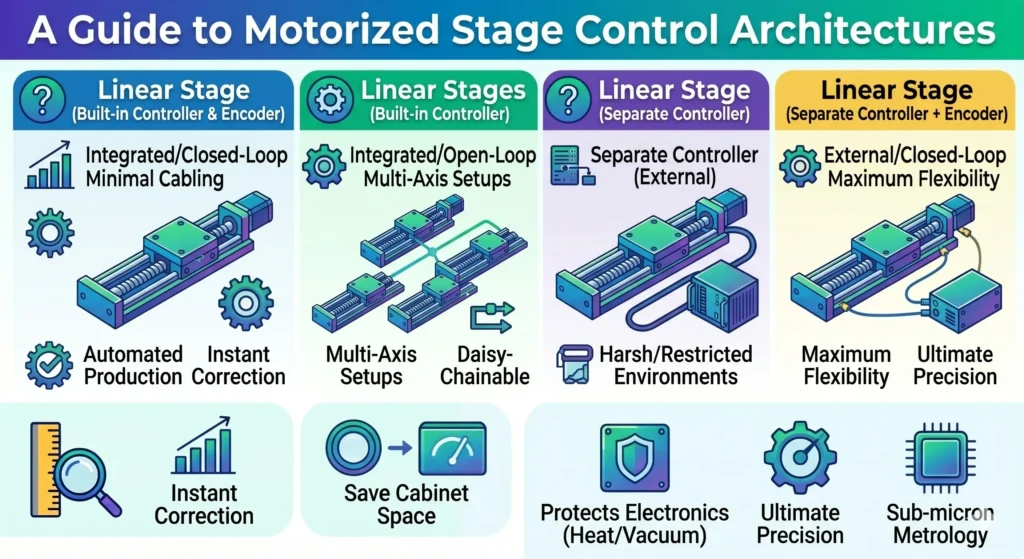
When choosing a linear stage, the biggest decision isn’t just the bearing type—it’s the control architecture. Use the table below to identify the best fit for your system integration:
| Linear Stage Type | Control Architecture | Best For… | Key Advantage |
|---|---|---|---|
| Built-in Controller & Encoder | Integrated / Closed-Loop | Automated production & error correction | Minimal cabling; instant real-time correction. |
| Built-in Controller | Integrated / Open-Loop | Multi-axis X-Y-Z setups | Daisy-chainable; saves significant cabinet space. |
| Separate Controller | External | Harsh or restricted environments | Keeps electronics safe from heat/vacuum. |
| Separate Controller & Encoder | External / Closed-Loop | Sub-micron metrology | Maximum control flexibility with high precision. |
| Vertical (Z-Axis) Stages | Integrated or External | Focus & elevation tasks | Engineered to handle gravity-stable loads securely. |
| T-Slot Compatible Stages | Versatile | Industrial prototyping | Rapid, rigid mounting to standard aluminum profiles. |
For applications requiring multi-axis coordination, this ability to seamlessly daisy-chain single-axis systems naturally leads us to the next tier of planar precision: the XY stage.
Critical Factors for Linear Stage Precision
To ensure your linear stage meets the demands of your application, evaluate these three performance metrics:
Load Capacity: Consider not just the static weight of your sample, but the dynamic forces during high-speed acceleration.
Travel Range: Systems can range from a few millimeters for fiber alignment to several meters for large-scale manufacturing.
Environmental Requirements: If working in cleanrooms or vacuums, you must select stages with specialized materials, coatings, and vacuum-compatible lubricants.
Conclusion: Elevate Your Motion Control
Selecting a linear stage is about balancing mechanical stiffness with electronic intelligence. While manual slides offer a baseline, motorized linear stages provide the automation and repeatability necessary for 21st-century innovation.
Ready to optimize your workflow? Explore our full range of motorised linear and vertical stages or contact our engineering team to discuss a custom configuration for your specific environment.