

















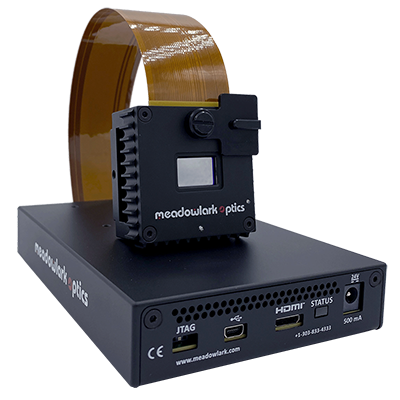
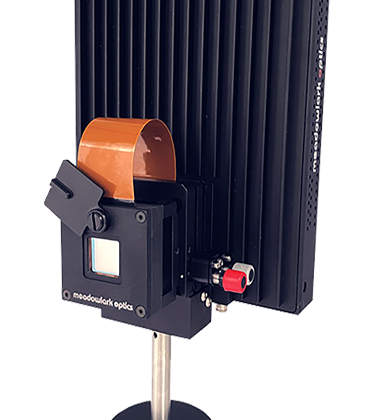
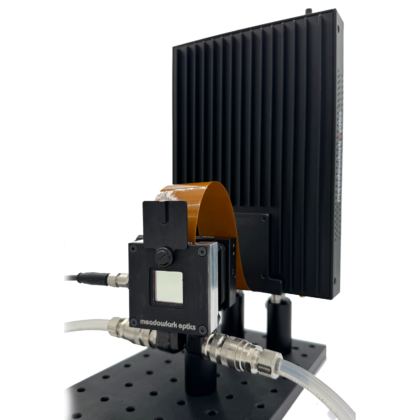
The S series high speed spatial light modulators (S19x12) from Meadowlark Optics is an upgrade to the E19x12 spatial light modulator, with improved phase control, increasing the dynamic range from 8-bit to 10-bit.
Designed for static to low-speed applications (up to 60Hz) where even greater phase control is needed, the S19x12, offers high resolution, exceptional stability and excellent phase control.
Key Features:
- Research-Grade: Perfect for applications that require precision control of phase at static to low speeds.
- 10-bit controller: Control phase with up to 1024 optically resolvable phase levels.
- High Phase Stability: Ideal for noise sensitive applications with phase ripple as low as 0.1%.
- Versatile Wavelength Support: Variants available to operate effectively across a wavelength spectrum from 400nm to 1650nm.
High Phase Stability:
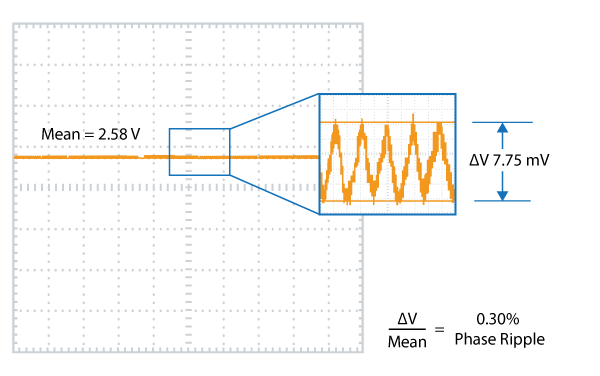
A powerful feature of these devices is their high phase stability which is achieved through the implementation of high speed direct analog backplanes and controllers. When driving liquid crystal devices, it is important to continually switch the polarity of the drive voltage. During this process, liquid crystal molecules have a natural tendency to relax and it is this process that causes instability in the liquid crystal orientation and therefore the phase delay of a given pixel. By increasing the speed at which the backplane refreshes the voltage, it is possible to minimize the amount of relaxation and therefore reduce the ripple to as low as 0.025% (0.0008 π radians). Standard E-Series SLM’s have a phase ripple in the range of 0.1-0.3%. Phase ripple is quantified by measuring the 1st order diffracted spot as compared to the mean intensity while writing a blazed phase grating to the SLM.
Diffraction Efficiency (1st Order)
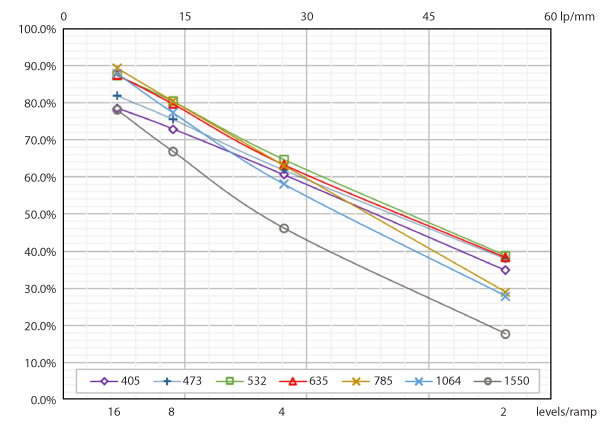
This is the percentage of light measured in the 1st-order when writing a linear, repeating phase ramp to the SLM as compared to the light in the 0th order when no pattern is written to the SLM. Diffraction efficiency varies as a function of the number of phase levels in the phase ramp such that as the number of levels / ramp decreases, we can gain insight into the efficiency of the SLM. Below we show data taken at 1064nm with phase ramps varying from 2 to 16 phase levels between 0 and 2π.
Intuitive Software and Development Kits
- User-friendly software provided
- Intuitive image generation and sequencing
- Software development kits available for Labview, Matlab, Python and C++
Image generation capabilities include:
- Bessel beams (spiral phase, fork, concentric rings, axicons)
- Lens functions (cylindrical, spherical)
- Gratings (blazed, sinusoid)
- Various diffraction patterns (stripes, checkerboard, solid, random phase)
- Holograms
- Zernike polynomials
- Image superposition